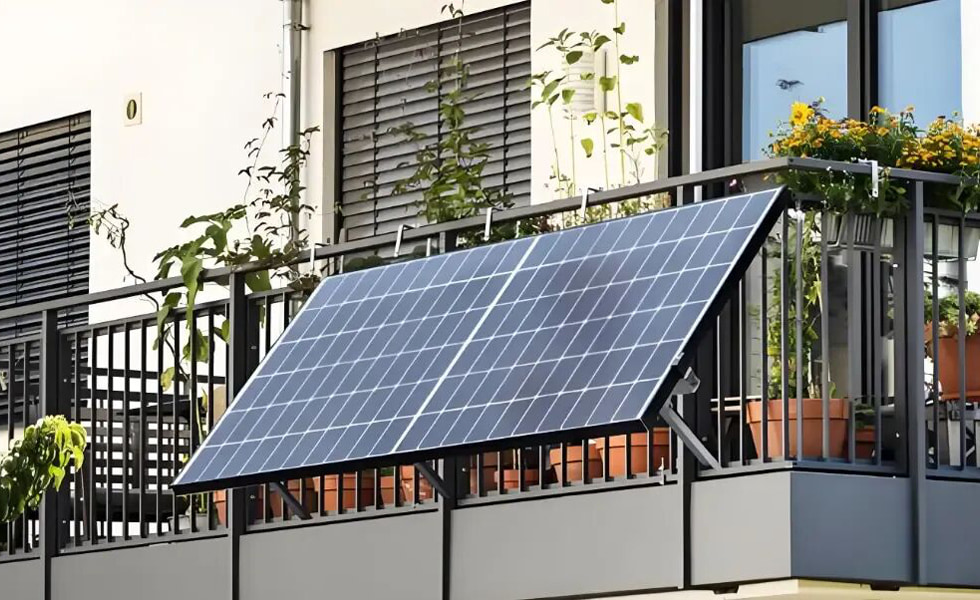
August saw two milestones for the global balcony solar market.
First, on August 27th, plug-in balcony solar systems were officially legalized in the UK. After years of operating in a legal gray area, British consumers can finally legally purchase a balcony solar system, plug it into their homes, and generate their own electricity. Reports indicate that retail giants such as Amazon, B&Q, Currys, and Lidl are already lined up to stock the system.
Market estimates suggest that approximately 4 million households in the UK are suitable for balcony solar installations. Assuming a penetration rate of 50%-70%, the market size is estimated at 2-3 million units, seemingly opening up another huge blue ocean for balcony solar energy in Europe.
Almost simultaneously, California's SB 868 bill also made significant progress in its legislative process. This legislation, known as the "Access to the Sun Act," proposes to reclassify small plug-in solar systems (400-1200 watts) as "household appliances," eliminating the need for complex grid connection approvals. Once legislation is finalized, California will become another US state to explicitly establish a legal framework for plug-in solar power.
It sounds like the era of balcony solar power has arrived. However, one detail has prevented those in the energy storage industry from celebrating—new UK regulations explicitly state: devices with built-in energy storage batteries are not allowed.
I. The UK: Legalized, but Energy Storage "Kicked Out of the Chat"
Let's start with the UK.
The amendments to the Plug and Socket Safety Regulations 1994 (SI 2026/848), which came into effect on August 27, created a completely new legal category for "plug-in microgenerators." Eligible products must meet the following stringent requirements:
• The maximum rated output power of the microinverter on the AC side must not exceed 800W;
• The equipment must be sold as a "complete certification kit"—the photovoltaic panels, inverter, cables, and installation accessories must be bundled together and certified under the Provisional Product Specification for Plug-in Solar Equipment (Revision 2);
• Registration with ENA (Energy Network Association) under the Plug-in-Solar category is mandatory;
Most importantly: it must not include a battery storage device.
The Provisional Product Specification states that the equipment "must not be designed for the purpose of receiving electrical energy from low-voltage user installations for storage and subsequent supply." In simpler terms, the electricity generated by the photovoltaic panels must be consumed directly or fed back to the grid; it cannot be stored in batteries and then used as a last resort.
The UK Department for Energy Security and Net Zero Emissions (DESNZ) also clarified in a public consultation from June 16th to 30th, 2026, that this regulatory revision only applies to "plug-in solar systems without batteries." Battery storage "requires its own regulatory path," which will be discussed later. Why?
The UK government's logic isn't hard to understand. A solar panel and a micro-inverter do something simple: deliver no more than 800W of electricity to a home when the sun is out. But adding batteries complicates things—batteries need to be charged and discharged, potentially drawing power from or feeding it back into the grid, and involve a host of issues such as thermal management, fire risks, and installation complexity. The UK government's approach is: do the simple things first, and tackle the complexities gradually.
DESNZ even issued a tender document (PS26239) on August 18, 2026, initiating a safety study on "plug-in batteries" to assess the electrical and fire safety risks of deploying plug-in batteries with up to 800W AC output in UK homes. After the study is completed, standards are established, and regulations are revised, this entire process will take until at least 2027.
In other words, from now until 2027, all legally compliant balcony solar products on the UK market will not include energy storage.
II. Market Impact: Is Pure Solar PV Still Cost-Effective?
The exclusion of energy storage has a real impact on the UK balcony solar market.
Firstly, the most popular "integrated" product form is effectively dead. Integrated "micro-inverter + battery" systems like Anker Solarbank and Zendure SolarFlow, which are wildly popular in the German market, cannot be sold legally under the first wave of UK regulations. Anker has explicitly stated that its Solarbank 4 battery products still require hardwiring by a certified electrician and cannot be plug-and-play.
Secondly, the economic model has changed. The core logic of making money with balcony solar has always been "energy storage"—storing electricity during the day and using it at night to avoid peak electricity prices. Without energy storage, the electricity generated by solar can only be used for immediate self-consumption or fed into the grid free of charge. However, the UK's Smart Export Guarantee (SEG) electricity sales revenue scheme requires MCS certification. Plug-in kits are not within the MCS system, and surplus electricity can only be given back to the grid for free.
So, is pure solar still economically viable?
Yes, but the payback period is longer. Carbon Brief's analysis shows that a typical balcony solar PV system generates approximately 400 kWh of electricity annually, accounting for about 15% of a typical household's annual electricity consumption, saving about £110 in electricity bills per year. The kit is expected to cost between £400 and £600, with a payback period of about 3 to 5 years. If the installation location is not ideal (east-facing, vertically installed, or obstructed), power generation may decrease by 30%-60%, doubling the payback period.
Third, want to install energy storage? Yes, but the cost will double. The new regulations do not prohibit users from installing energy storage batteries, but it's not "plug and play." Systems with energy storage must be installed by a licensed electrician and hardwired to the user's unit, with electrician fees alone ranging from £250 to £450. Adding the cost of the batteries themselves, a 10 kWh home energy storage system in the UK costs approximately £6,000-£9,400, a completely different level of investment compared to a balcony solar PV kit costing a few hundred pounds.
In short, the first wave of balcony solar PV in the UK is a "pure solar, unsubsidized, self-installed" version. For consumers, it remains a worthwhile investment; a few hundred pounds invested, payback in three to five years, and then pure profit. However, for energy storage companies, this market is not yet fully open.
III. California, USA: More Cautious, but with Backdoors
Let's look at California across the ocean.
SB 868 is progressing more slowly than the UK, but the direction is the same: allowing small-scale photovoltaic equipment to bypass the cumbersome grid connection approval process.
According to the latest bill text on August 17, 2026, eligible products must meet the following requirements:
• The total maximum AC output power of all devices per household does not exceed 1.2kW;
• The equipment is designed to connect via a standard 120V outlet, not fixed wiring;
• It must comply with the latest version of the NEC (National Electrical Code) and California electrical codes;
• It must be certified by UL or other nationally accredited laboratories;
• It must have certified anti-islanding capabilities—automatic disconnection during grid outages.
Once passed, the bill would exempt eligible portable solar PV devices from all grid connection requirements stipulated by state law, the California Public Utilities Commission, and power companies, including signing traditional grid connection agreements. Power companies could at most require users to fill out a simple online registration form; registration would be merely a "notification," not a new approval process.
However, the situation for energy storage is far more complex.
In May of this year, when Scott Wiener's office introduced SB 868, plug-in solar PV was described as "consisting of a small number of solar panels, inverters, and small-scale energy storage." However, in the latest version of the bill on August 17th, the formal definition of "Portable Solar Generation Device" primarily focuses on solar power generation equipment, without explicitly requiring or defining the inclusion of energy storage batteries.
In other words, California has left a door open for energy storage, but how wide and how it will be opened remains unclear.
Some analysts point out that while SB 868 does not directly regulate battery systems, combining solar panels with energy storage is the way to maximize value. Some industry organizations have even suggested explicitly requiring "solar PV and battery pairing" in the bill.
California's stance is more open than the UK's, but also more uncertain. The bill is still in the legislative process, and the final version's wording, whether energy storage will be explicitly included or excluded, remains to be seen.
IV. Why Neither Includes Energy Storage?
The UK and US markets almost simultaneously legalized balcony solar panels, yet both maintained a distance on the issue of energy storage. The core reason is the same: the complexity of safety regulations is on a completely different scale.
Solar panels with micro-inverters represent a unidirectional energy flow. DC to AC is used to supply electricity to homes. As long as anti-islanding measures are implemented (automatic disconnection during grid outages), grid-side risks are largely manageable.
Energy storage batteries, however, are bidirectional. They draw power from the grid (charging) and may also supply power to the grid (discharging); they involve thermal management of lithium-ion batteries and fire safety; their installation and use are too complex for ordinary consumers.
This is why the UK's DESNZ explicitly stated in its consultation document that batteries require their own regulatory path. While California legislators haven't explicitly stated it, the evolution of the bill's text suggests a similarly cautious approach to energy storage.
The Box believes that the widespread adoption of balcony solar power will ultimately force the improvement of energy storage policies. Germany has already installed over 1 million balcony solar systems, and energy storage penetration is rapidly increasing. The UK and California are following the path Germany took a decade ago.
In the UK and US markets, the safest approach is to first legalize and get the simplest solar products running, building up the market size, and then gradually improve the regulatory framework for energy storage. This is the most prudent path for the government.
For relevant companies, although they can't jump on the bandwagon immediately, they can make some preparations.
First, the UK market is currently dominated by "pure solar" systems, but the window of opportunity for energy storage is closing. DESNZ has already initiated safety research on plug-in batteries, and regulations are expected to gradually loosen by 2027. Now is the critical period for product planning, channel layout, and standard follow-up. Waiting until regulations are relaxed before taking action will be too late.
Second, product forms need to be rethought. For example, the UK requires "complete certification kits," excluding players who supply components or microinverters separately. Energy storage companies that only produce batteries and not systems won't even get a foothold in this market. System integration capabilities will become the core competitive advantage.
Third, California presents greater uncertainty, but also more noteworthy opportunities. Its 1.2kW capacity limit is higher than the UK's 800W, indicating a larger market potential. If the final legislation explicitly includes energy storage, California could become the first major growth area for balcony-mounted solar-energy storage in the US. It is recommended to closely monitor the legislative process of SB 868, especially the final version's stance on energy storage.