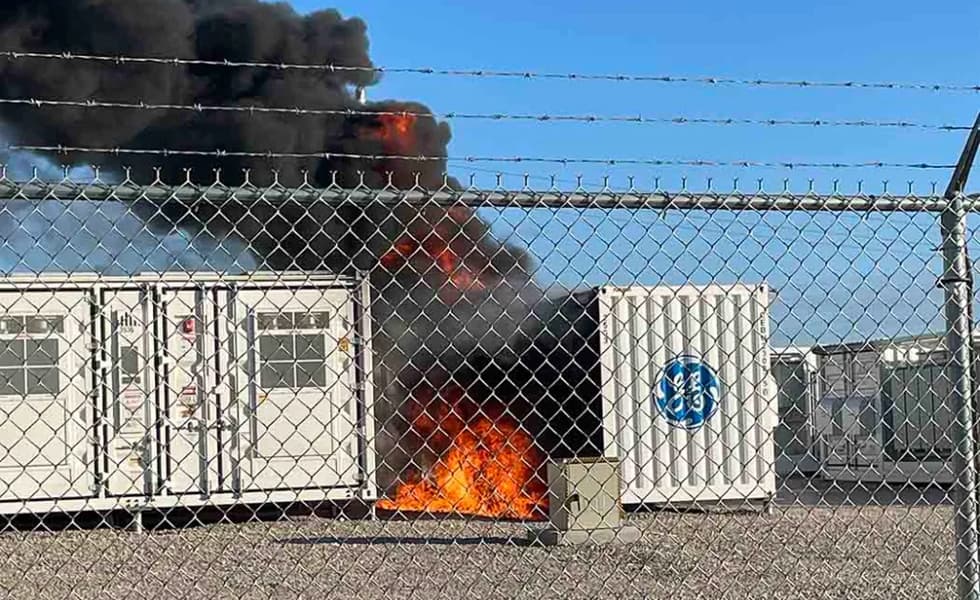
With two fires occurring in just 10 days, energy storage safety has once again become an unavoidable topic for the industry.
On October 2, a Power Conversion System (PCS) unit caught fire at the Kayak Energy Storage Center in Florida, USA; even after the open flames were extinguished, the unit continued to smolder for another four hours. On October 12, a fire broke out in the finished-goods warehouse of a lithium-battery manufacturing plant in Dangjin, South Chungcheong Province, South Korea.
From core equipment at energy storage power stations to finished-goods warehouses at lithium-battery manufacturing facilities, these successive fire incidents have once again thrust safety concerns into the spotlight.
01. Two Fires in 10 Days: Energy Storage Sites and Lithium-Battery Plants
Let’s look at the incident in the United States first. According to Holt Enterprise News, a Power Conversion System (PCS) unit caught fire on October 2 at the Kayak energy storage site in Holt, Florida.
Initially, the incident was reported as a small brush fire; however, upon arrival, firefighters discovered that surface temperatures 91 meters away from the blaze had reached 500°C—indicating a situation far more complex than first assumed. Fortunately, the fire was contained within a single PCS cabinet, preventing it from spreading to the 24 nearby battery containers and 23 other PCS units. Nevertheless, containing the flames did not mean the risk had immediately vanished; the affected unit continued to smolder for four hours.
It is reported that the PCS unit in question was manufactured by GE Vernova. The energy storage project had only begun operations in December 2023—meaning the fire occurred just about 10 months after the project went online.
Meanwhile, in South Korea, a fire broke out on the morning of October 12 at a finished-goods warehouse belonging to a lithium-battery manufacturer in Dangjin, South Chungcheong Province. Emergency services dispatched 32 pieces of equipment and over 80 personnel to the scene, and it took nearly three hours to extinguish the blaze. Fortunately, no staff members were inside the warehouse when the fire started. According to officials from the fire department, preliminary assessments suggest the fire may have been triggered by "thermal runaway" in lithium batteries stored within the warehouse.
Even more concerning is that a similar fire occurred at the same facility just over a month ago—on the morning of August 31 (local time)—also caused by thermal runaway within the batteries. That incident destroyed approximately 15 tons of lithium batteries; the warehouse spanned 703 square meters, with 234 square meters affected by the fire.
From fires involving Power Conversion System (PCS) equipment at energy storage stations to repeated blazes in the finished-goods warehouses of lithium-battery manufacturers, these incidents—occurring at different stages of the supply chain—all point to a persistent, unavoidable safety challenge within the energy storage industry.
Looking at a broader timeline, such fires are not isolated cases.
In late July of this year, multiple fires involving lithium-ion energy storage systems broke out in California and North Carolina, USA. On August 26, a battery room at an energy storage facility in Romania caught fire, and on August 30, a fire broke out overnight in a workshop used for aging tests on battery cells at Jiangxi Far East Battery.
On September 18, the Moss Landing energy storage station in California—once the largest of its kind globally—experienced yet another fire; it has now seen at least five such incidents since beginning operations five years ago. Just three days later, on September 21, a containerized energy storage system at a research complex belonging to the Korea Electric Power Corporation (KEPCO) also caught fire, destroying 28 lithium-ion battery packs and requiring nearly four hours for firefighters to extinguish the blaze.
02. Why are energy storage fires so difficult to extinguish?
Why are these fires occurring so frequently? To understand this, one must first look at the concept of "thermal runaway" in lithium batteries.
Many people assume that a battery fire is no different from an ordinary fire and can simply be put out with water. However, the true complexity of a lithium-battery fire lies in the thermal runaway occurring deep within the battery cells. In simple terms, "thermal runaway" refers to a phenomenon—triggered by internal or external factors—in which a battery (particularly a lithium-ion battery) generates heat much faster than it can dissipate it. This causes a rapid rise in temperature, setting off a series of irreversible, exothermic chemical chain reactions that can lead to fires, explosions, or the venting of high-temperature gases.
The risk in energy storage power stations stems from the fact that a large number of battery modules are concentrated within a limited space. If a single battery cell enters thermal runaway, the heat can spread to adjacent cells, triggering a chain reaction. Even more concerning is that, even after open flames are extinguished, the battery may continue to generate heat internally, posing a risk of reignition.
This is why, even when a fire at an energy storage facility appears to be under control, the site often requires prolonged monitoring and ongoing management. For large-scale battery systems, extinguishing the fire is merely one part of the emergency response; curbing the spread of thermal runaway and mitigating the risk of reignition are equally critical to safety management.
Consequently, ensuring safety in energy storage goes far beyond simply installing fire-suppression equipment. As the industry expands rapidly, certain long-standing shortcomings have begun to surface.
First, cutthroat price competition squeezes out "invisible" safety costs. In a highly competitive market, system integrators often drive down bids, leading to the persistent thinning of project budgets. Compared to factors like equipment pricing, delivery timelines, and projected returns, elements such as fire-protection configurations, equipment selection, system safeguards, and long-term operations and maintenance (O&M) do not always yield immediate, tangible value—yet they require continuous investment. If a company treats safety as a cost that can be trimmed, the savings realized upfront may eventually manifest as unmanageable risks down the line.
Second, rushing project schedules can introduce hidden hazards into a power station. Energy storage projects are often driven by the need to meet grid-connection deadlines or capture market windows, placing intense pressure on construction timelines and the realization of financial returns. If critical phases—such as design validation, construction management, or commissioning and acceptance—are compressed, safety risks may be embedded into the facility before it even begins operation.
Finally, because the condition of batteries evolves over time, ensuring the effectiveness of monitoring systems, the proper functionality of fire-suppression equipment, and the timely response to anomaly alerts requires consistent, long-term maintenance. Emergency response plans cannot simply remain on paper; they must be tested through drills to verify actual response capabilities. If significant investment is poured into the initial construction phase but by inadequate long-term operation and maintenance (O&M), the power station may gradually develop risks over the course of its operational life.
Ultimately, energy storage safety is a systemic endeavor that spans the entire lifecycle—from design and production to construction and operation. While the risk of thermal runaway in batteries cannot be entirely eliminated, the likelihood of incidents can be reduced through sound system design, effective thermal propagation protection, reliable fire-suppression configurations, and consistent O&M management.
03. Acceleration of Energy Storage Safety Standards: Moving Beyond a "Race to the Bottom" on Price
In light of frequent fires at energy storage facilities, the industry must shift its focus from merely conducting post-incident root-cause analyses to proactively establishing robust safety defenses. Currently, the framework of standards and regulatory requirements for energy storage safety in China is undergoing continuous refinement.
On April 1, 2026, the updated *Design Standard for Electrochemical Energy Storage Power Stations* (GB/T 51048-2025) will officially take effect, replacing the 2014 version. Concurrently, the National Energy Administration and the Standardization Administration of China have jointly issued the Guidelines for Developing a Standards System for New Energy Storage. This initiative aims to build a comprehensive standards framework covering eight key areas: fundamental/general requirements, planning and design, equipment testing, construction and acceptance, grid-connection, inspection and monitoring, O&M, and safety/emergency response.
This signifies that energy storage safety is no longer viewed merely as an isolated issue concerning batteries or fire-suppression equipment; rather, it must be integrated into every stage of a project—from design and construction to ongoing operation and maintenance. Clearer standards are now required for aspects such as power station layout, equipment selection, system testing, and post-commissioning monitoring and maintenance.
From a regulatory perspective, requirements are also becoming more granular. The Provisions on the Identification, Remediation, and Supervision of Major Accident Hazards in the Power Sector—effective July 1, 2026—explicitly classify certain scenarios as "major accident hazards." These include cases where a facility with a grid-connection voltage of 220 kV or higher lacks the grid-integration capabilities mandated by national standards, or fails to complete required grid-connection testing. The signal is clear: energy storage safety is not merely a matter of preventing battery fires or ensuring a timely emergency response; it is also fundamental to the safe and stable integration of energy storage power stations into the power grid. As regulatory requirements expand from the equipment itself to encompass grid-connected operations and broader power system security, energy storage projects are facing increasingly comprehensive scrutiny.
While regulations continue to evolve, their ultimate effectiveness depends on how enterprises translate them into concrete action. For energy storage projects, safety capabilities are becoming an increasingly critical competitive factor. The reliability of fire-safety design, the robustness of equipment protection systems, and the sustained efficacy of operations and maintenance (O&M) frameworks all directly influence the long-term operational stability of a project. Strategies that rely solely on low-price competition or the aggressive compression of construction timelines are becoming increasingly unsustainable for the industry’s long-term development.
From the fire involving a Power Conversion System (PCS) unit at an energy storage station in the United States to a series of blazes at lithium-battery warehouses in South Korea, recent incidents serve as a stark reminder: the true value of energy storage lies not just in its capacity to store electricity or generate revenue, but in its ability to operate safely over the long term.
The industry may be accelerating, but safety must not be left behind. The refinement of standards is merely a starting point; the ultimate safeguard for safety is the ability of enterprises to embed these requirements into every stage—from design and construction to operations and maintenance. Only by treating safety as an essential, foundational investment—rather than a cost to be trimmed—can the energy storage industry achieve growth that is truly resilient and sustainable.