Can you imagine that highways are now participating in the electricity and ancillary services markets?
On May 19th, Shaanxi Transportation Holding Group successfully obtained official provincial-level access qualifications for virtual power plant business, acquiring full qualifications for load dispatching, distributed energy aggregation and management, and power resource optimization, entering a new stage of dual-engine development of electricity sales and virtual power plant operation.
Not only Shaanxi, but also Shandong, Yunnan, Zhejiang, Guangdong, and other provinces are following suit.
So, the widespread deployment of "transportation + energy" integration in multiple regions inevitably raises questions: is this a strategic move to capitalize on the trend, or simply a change of name to ride the wave?
1. Widespread Development: Highway Virtual Power Plants Usher in a Wave of Implementation
First, it's important to understand why companies operating highways would participate in electricity trading.
In the past, the installation of photovoltaic projects, energy storage power stations, and charging piles along highways was primarily for self-consumption, driven by energy conservation and carbon reduction considerations.
However, the emergence of virtual power plants has rewritten this logic. Essentially, it's a digital dispatch system that aggregates resources such as photovoltaic power, energy storage, charging piles, and adjustable loads scattered across different nodes through communication technology and a software platform. This allows for unified control and participation in the electricity market as a whole.
The revenue boost that virtual power plants bring to highways after operation is tangible, as demonstrated by Shandong Expressway Group.
At the end of 2025, the virtual power plant built by Shandong Expressway Group's Energy Development Company was successfully registered and became the first power generation virtual power plant in the highway sector in China.
The project selected three photovoltaic-energy storage sites along the route with large energy storage capacity and good regulation capabilities, totaling 11.07MW. Through a self-developed edge intelligent controller and management platform, it achieves aggregated dispatch of dispersed resources, solving the problem of idle and wasted photovoltaic power while generating revenue through electricity price differences and grid services, truly making idle roadside resources valuable.
It is estimated that the virtual power plant can generate approximately 3.02 million yuan in annual revenue after operation. In 2025, Shandong Hi-Speed Group traded 465,000 green certificates, generating 81.136 million yuan in green electricity revenue—almost zero in previous accounts for the expressway industry.
Following Shandong, Yunnan is also accelerating its development. In early 2026, Yunnan Transportation Investment Group's virtual power plant received provincial official certification, aggregating 136 users and achieving a measured regulation capacity of 2.97MW.
This project leverages abundant local solar resources, integrating distributed photovoltaic power, energy storage devices, and charging networks along the expressway. It aligns with the regional energy pattern of "West-to-East Power Transmission," ensuring local grid load stability while enabling local production and use of green electricity, precisely meeting the unique energy development needs of Southwest China.
In addition, pilot projects for virtual power plants along expressways in the Yangtze River Delta and Pearl River Delta regions are more focused on intelligence and diversification.
Zhejiang has integrated a virtual power plant dispatch system into its Hangzhou-Shaoxing-Ningbo smart expressway, combining energy management with smart transportation and autonomous driving scenarios. Guangdong, based in the Greater Bay Area, is exploring a new model of "expressway + energy storage + vehicle-to-grid interaction." Jiangsu and Henan, leveraging their transportation hub advantages, are revitalizing service area electricity and charging resources to participate in regional power grid load regulation.
Different regions are adapting to local conditions, making the development pattern of expressway virtual power plants increasingly complete.
2. Inherent Advantages: Expressways are More Suitable for Virtual Power Plants
With the deepening of power market reforms, the concept of virtual power plants is gradually becoming more widespread. Industrial parks and high-energy-consuming factories are implementing them. So, what advantages do expressways have to gain a share of the market?
First, they have a high concentration of resources, which is difficult for industrial parks and factories to replicate. Industrial parks often involve multiple enterprises with significantly different electricity usage times and loads, resulting in dispersed resources and difficulties in overall coordination. While factories have stable adjustable loads, their scale is limited and they are primarily driven by electricity load, making it difficult to form a complete energy operation loop.
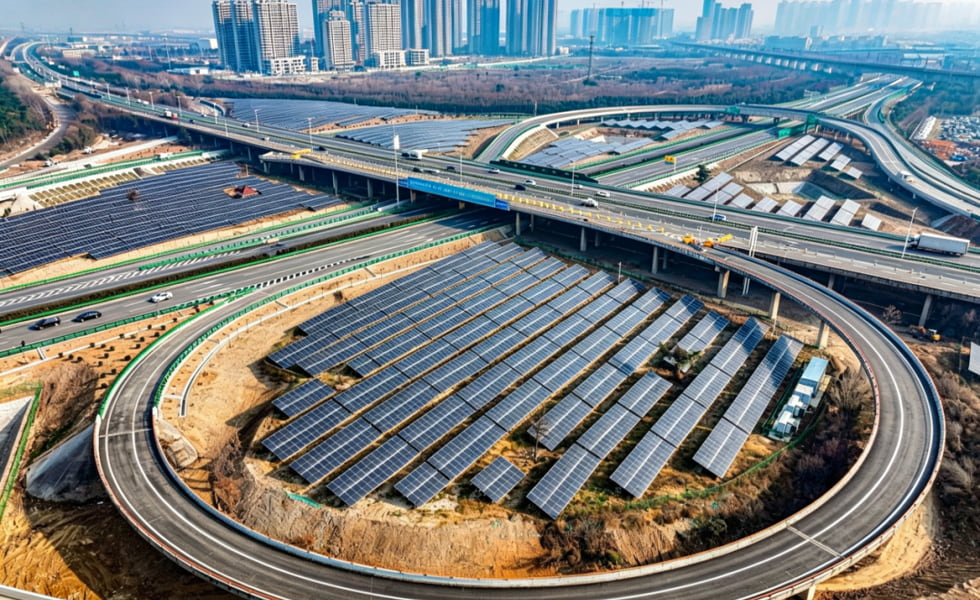
Highways, however, are different. They traverse the entire region, and the rooftops of service areas, roadside slopes, and open spaces along ramps all provide excellent sites for photovoltaic (PV) installations. Simultaneously, the lighting and ventilation equipment at toll stations, tunnels, and service areas create stable and controllable power loads. Combined with the widespread charging piles and energy storage devices along the road network, highway resources are more concentrated, larger in scale, and more stable. With unified ownership, they are more suitable for centralized dispatch and operation.
In terms of actual installed capacity, Shandong Expressway Group has already built over 806,000 kilowatts of roadside PV, ranking first in the national transportation industry; Shaanxi Transportation Holding Group has already built over 133 MW of roadside PV installed capacity, with a second-phase plan for 240 MW of PV installed capacity, and a concurrent plan for approximately 56 MW/111 MWh energy storage projects. The group's annual electricity consumption is close to 1 billion kilowatt-hours, indicating a huge potential for flexibly allocated power resources.
Furthermore, the dispatching scope and coverage of virtual power plants on highways are larger. Roadside energy storage and adjustable loads are proactively released during peak grid periods and absorb excess power during off-peak periods, directly participating in peak shaving and valley filling of the regional power grid. In the event of extreme weather or grid failures, the energy storage and power generation equipment of the highway network can act as emergency power sources, ensuring the normal operation of service areas, tunnels, and toll stations is not disrupted by external power outages.
3. The greater the market potential, the greater the challenges.
While pilot projects of cross-border virtual power plants on highways in various regions have yielded significant results, achieving stable commercial operation from scattered pilot projects still faces considerable challenges.
Firstly, resource dispatching and management present high technical difficulties. While highways have a concentrated overall resource volume and unified ownership, various energy facilities are linearly distributed along the road network, with numerous service areas, tunnels, toll stations, and roadside photovoltaic and energy storage sites spanning a large spatial area.
Connecting all massive independent nodes to a unified dispatching platform to achieve real-time data acquisition and minute-level load response places stringent requirements on hardware reliability, communication link quality, and intelligent dispatching algorithms.
The wider the coverage area and the more complex the on-site conditions, the greater the difficulty in system coordination. The entire dispatching platform not only requires stable hardware support but also demands algorithms with good adaptability and fault tolerance.
Secondly, the availability of energy storage brings dual constraints on investment and profitability. Energy storage is crucial for virtual power plants to achieve load regulation and smooth power generation fluctuations. Without sufficient energy storage, the photovoltaic power in the road area cannot be fully utilized, and peak loads at charging stations cannot be effectively staggered, thus hindering the project's adjustable capabilities.
However, energy storage projects have high initial investment costs and long overall payback periods. Furthermore, the electricity spot market and ancillary service market mechanisms in many parts of China are still under development, resulting in significant price fluctuations and making it difficult to guarantee the stability of returns on energy storage assets.
In addition, cross-industry collaboration and a lack of professional capabilities are also significant barriers. Transportation operating companies have long focused on road network management and traffic services, and generally lack experience in electricity market trading rules, bidding strategies, and risk management, resulting in insufficient professional talent reserves.
At the same time, the project involves multiple management areas such as transportation, power grid, and energy. Different areas have different regulatory requirements and procedures, and there are still many bottlenecks in inter-departmental collaboration. Conclusion
Overall, virtual power plants on highways possess a clear development logic and broad market prospects, and have received strong policy support. However, various practical challenges objectively exist, and the industry as a whole is still in the pilot and exploratory stage.
For highways, the real value of promoting virtual power plant projects lies not in earning more short-term profits through electricity trading, but in redefining roadside assets, fully revitalizing previously dormant energy resources within the road network, and opening up new space for the transformation of the transportation industry.