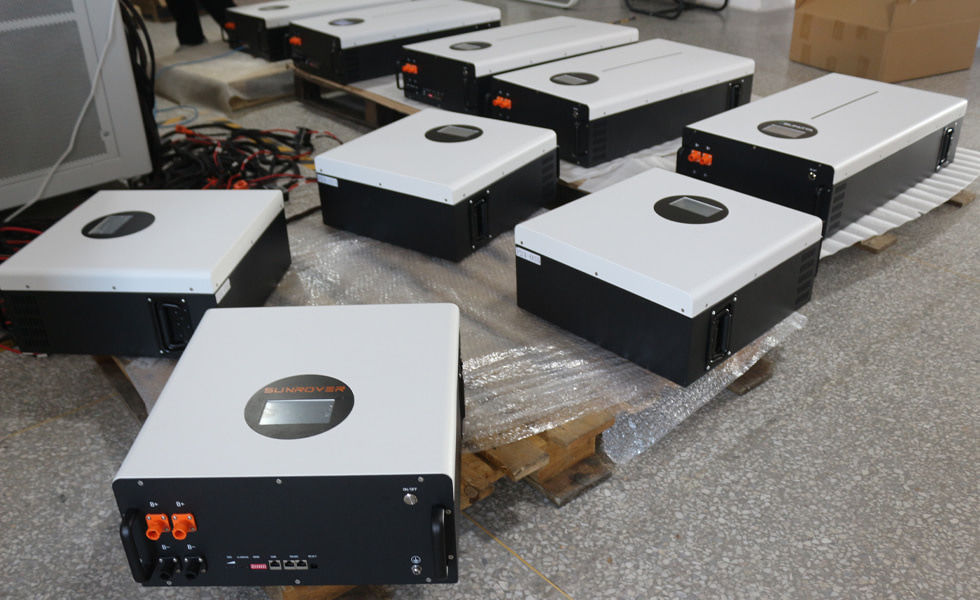
The booming energy storage market was foreseeable. "Energy storage," as the name suggests, involves storing electrical energy. Storing electrical energy requires a medium or container, and batteries are precisely the containers that store electrical energy.
Generally, two main types of batteries are used in photovoltaic energy storage systems: lead-acid batteries and lithium-ion batteries.
01. Lead-acid Batteries
Lead-acid batteries are chemical energy storage devices that use lead and lead dioxide (PbO₂) as the active materials for the negative and positive electrodes, and dilute sulfuric acid as the electrolyte. Essentially, they achieve the interconversion between electrical energy and chemical energy through electrochemical reactions; they are the preferred chemical power source for various energy storage systems, emergency power supplies, and soft/black start devices.
A single lead-acid battery cell has a nominal voltage of 2.0V, can discharge to 1.5V, and can charge to 2.4V. In practical applications, six cells are often connected in series to form a lead-acid battery module with a nominal voltage of 12V. Then, by appropriately linking cells in series and parallel, the system's acceptable voltage (such as 48V or 96V) is obtained, enabling normal charging and discharging.
The main components of a lead-acid battery include: positive and negative terminals, plates, separators, electrolyte, and a container. Because the battery module contains a large amount of chemical solution, it is generally quite heavy.
Lead-acid batteries mainly include general flooded lead-acid batteries, gel maintenance-free (solar-specific) lead-acid batteries, and lead-carbon batteries. In practical use, gel batteries and lead-carbon batteries are increasingly prevalent. Gel batteries exhibit superior over-discharge resistance, self-recovery capability, and low-temperature charge-discharge performance. Lead-carbon batteries, due to the addition of carbon (graphene) to the electrolyte, prevent sulfation at the negative electrode, mitigating battery failure and significantly extending battery life.
Lead-acid batteries typically employ three charging modes: constant current, constant voltage, and float charging, also known as three-stage charging. Charging current is a crucial parameter, usually expressed in C. Battery specifications clearly indicate the maximum charging current, typically 0.1C, 0.2C, or 0.3C. For example, a battery with a capacity C of 200Ah would require a charging current of 0.1C (0.1 × 200 = 20A) and 0.2C (0.2 × 200 = 40A). The optimal charging current for maintenance-free lead-acid batteries is around 0.1C; excessively high or low charging currents will negatively impact battery life.
02. Lithium Batteries
Lithium batteries are a type of battery that uses lithium metal or lithium alloys as positive/negative electrode materials and a non-aqueous electrolyte solution; they are mainly divided into lithium metal batteries and lithium-ion batteries. Generally, when people talk about lithium batteries, they are referring to lithium-ion batteries, which are rechargeable batteries, meaning they can be charged and discharged. Lithium-ion batteries use lithium alloy metal oxides as the positive electrode material and graphite as the negative electrode material. The negative electrode material is the main component storing lithium in a lithium-ion battery, and it plays a crucial role in the battery's charge/discharge efficiency, cycle life, and other performance characteristics.
Lithium-ion batteries are mainly classified according to the different positive electrode materials, including lithium cobalt oxide batteries, lithium manganese oxide batteries, lithium nickel oxide batteries, lithium iron phosphate batteries, and ternary lithium batteries.
Considering factors such as price, cost, performance, and safety, lithium iron phosphate batteries are more commonly used in practical energy storage systems. Lithium iron phosphate batteries are generally considered to contain no heavy metals or rare metals, making them non-toxic, pollution-free, and environmentally friendly batteries. It uses lithium iron phosphate (LiFePO4) as the positive electrode material and carbon as the negative electrode material. The rated voltage of a single cell is 3.2V, and the charging cut-off voltage is approximately 3.6V~3.65V. The required voltage and capacity are achieved through series and parallel connections.
03. Energy Storage Battery
Selection Many customers are still confused about how to choose the right energy storage battery in actual system design. Selection can be approached from the following three aspects:
Lead-acid battery or lithium battery
First, batteries account for a high proportion in energy storage systems. For energy storage inverters that support both lead-acid and lithium batteries, the choice depends on investment intentions, project type, project location, warranty requirements, etc. Lithium batteries have a higher energy density (ρ=E/V), approximately 6 to 7 times that of lead-acid batteries. They are also smaller, lighter, and have a longer cycle life, 1.5 to 5 times that of lead-acid batteries. Therefore, batteries covered by warranty by energy storage device manufacturers are generally lithium batteries. However, lithium batteries perform worse at low temperatures and are also more expensive, typically costing 2 to 4 times more than lead-acid batteries.
Capacity Selection
Secondly, the selection of battery capacity should primarily be based on the user's energy storage needs, while also considering the system capacity. For example, if a user needs to store 30 kWh/day of electricity and has installed a 3 kW off-grid energy storage system without grid-connected power, then their batteries will require at least two days to reach full charge; during periods of continuous rain, they may not be able to fully charge for an extended period. In such cases, various constraints need to be considered during the system design phase, such as increasing the installed capacity of photovoltaic modules and increasing the output capacity of energy storage control equipment. Lead-acid battery specifications are typically expressed as "xxx V/ xxx Ah," for example, the common 12V/100Ah. The capacity of a single battery is 12 × 100 = 1200 Vah = 1200 Wh = 1.2 kWh, or 1.2 kilowatt-hours. If a storage capacity of 30 kWh is required, approximately 30 ÷ 1.2 = 25 batteries would be needed. For lithium batteries, selection is generally based on the capacity of a single battery pack. For example, a single battery pack has a capacity of 2.56 kWh; two packs would have a capacity of 5.12 kWh, and ten packs would have a capacity of 25.6 kWh.
High-voltage or low-voltage batteries
Energy storage inverters come in high-voltage (HV) and low-voltage (LV) series. Correspondingly, batteries also come in high-voltage and low-voltage types. Generally, single-phase output energy storage units are paired with low-voltage batteries, with a terminal voltage of approximately 48V~52V. If lead-acid batteries are used, 48V can be achieved by connecting four 12V batteries in series. If lithium batteries are used, a 48V battery pack can be directly selected. Three-phase grid-connected (hybrid) energy storage units can be paired with high-voltage batteries, with voltages ranging from approximately 100V to 550V. Higher-power integrated units have even higher battery voltages; for example, the Growatt WIT-H series grid-connected unit has a rated battery voltage of 768V, with a voltage range of 600V to 1000V. The series-parallel connection method is similar to that of low-voltage batteries.
In summary, we can see that lead-acid and lithium batteries each have their advantages and disadvantages. Generally speaking, lithium batteries are relatively more high-end, but they are also more expensive. Currently, they are more widely used in overseas markets such as Europe, America, and Australia. New energy is a trend, and the huge market demand will be an inexhaustible driving force for rapid technological development. It is believed that in the near future, the price of lithium batteries will reach a range acceptable to the general public, and many fields, including new energy vehicles, photovoltaic energy storage systems, and portable power supplies, will benefit from this.