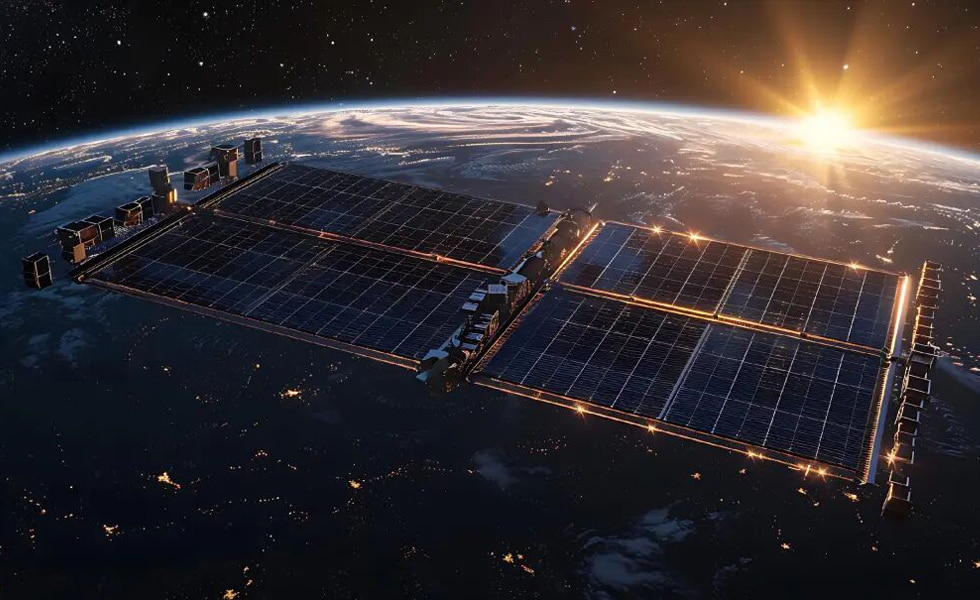
SpaceX's space photovoltaic story is facing a new test.
On July 17th, Beijing time, SpaceX's 13th Starship test flight was aborted at ignition due to an malfunction in four engines. The giant rocket remained motionless on the launch pad. Following the news, the stock price fell by more than 3% in after-hours trading.
From the overwhelming enthusiasm on its first day of trading to a month later, the capital market has cast a vote of no confidence: the commercialization of space photovoltaics is far more fragile than imagined.
I. Starship Launch Setback: When Will Space Photovoltaics Be Realized?
This aborted 13th Starship test flight was originally a crucial test mission in the commercialization process of space photovoltaics. According to the original plan, this flight would carry 20 new Starlink V3 commercial satellites, which is SpaceX's current highest-specification and most powerful next-generation satellite platform with the largest photovoltaic system.
It is reported that the flexible photovoltaic array on a single Starlink V3 satellite has a wingspan of 60 meters, roughly the size of two standard basketball courts, making it the largest space photovoltaic module currently deployed on a large scale in the commercial space industry.
Due to its size, payload, and deployed dimensions far exceeding those of its predecessors, the traditional Falcon rocket's launch space and capacity are completely incompatible. The mass deployment of these satellites relies entirely on the Starship's ultra-heavy launch capability.
The fact that investors were willing to value SpaceX at two trillion dollars largely reflects this logic: Starship will drive down launch costs, allowing large-scale photovoltaic satellites to be launched in large numbers, and turning the space photovoltaic business from a PowerPoint presentation into a cash flow.
As planned, this batch of on-orbit photovoltaic arrays undertakes a dual mission. On one hand, the ultra-high-power space photovoltaic system provides continuous and stable power to Starlink V3's high-performance communication and laser interconnection equipment, supporting the upgrade of the low-Earth orbit satellite network to the next generation.
On the other hand, through long-term on-orbit operation, it verifies the power generation stability and degradation patterns of large-scale flexible photovoltaics under the harsh environments of space, such as extreme temperature differences and high-energy radiation, accumulating experimental data for future large-scale orbital solar power plants.
However, the sudden malfunction that aborted ignition exposed the current technological shortcomings of heavy-duty reusable rockets. As the only launch vehicle for large-scale, orbital deployment of space photovoltaics, Starship's test flights have been repeatedly delayed, directly impacting the Starlink V3 network deployment schedule and slowing down the progress of space photovoltaics from technology testing to commercial verification.
At this point, the industry is reaching a clear consensus: the commercialization of space photovoltaics is no longer limited to photovoltaic materials and module technology. The maturity of the launch vehicle and the stability of its launch are the real first hurdle.
II. Accelerating the Localization of the Photovoltaic Industry
The Starship launch malfunction led the capital market to lower its short-term expectations for space photovoltaics, but the United States did not slow down. Just ten days before the test flight was aborted, another strategic move was quietly made.
On July 7, 2026, the U.S. Department of Defense used funds specifically allocated under Chapter III of the Defense Production Act to invest $7.1 million in an Ohio company to expand its domestic production line for aerospace photovoltaic cover glass. While the amount of money involved isn't large, the legal basis for the investment and the targeted industry segment warrant close examination.
Aerospace photovoltaic cover glass and the ultra-clear rolled glass commonly used in ground-based power stations are completely different products. During satellite operation, the cover glass needs to continuously withstand cosmic ray radiation, alternating temperatures of hundreds of degrees Celsius, atomic oxygen erosion, and impacts from micro-meteorites.
It must filter harmful rays, maintain light transmission stability, and act as a physical barrier to protect the delicate photovoltaic cells inside. If the glass blackens or cracks due to radiation, the satellite's power generation efficiency will plummet, significantly shortening its on-orbit service life.
For a long time, this crucial material has relied on overseas supplies, resulting in long delivery cycles, high geopolitical risks, and the potential disruption of US military and commercial satellite production.
Michael Cardnazzi, Assistant Secretary of Defense for Industrial Base Policy, stated bluntly that aerospace-grade cover glass is a core component for the long-term operation of satellite power systems, and domestic manufacturing capabilities directly impact the security of space assets and the smooth progress of orbital missions. The strategic intent behind using the Defense Production Act to support a glass production line is self-evident.
From a broader perspective, this investment is merely a microcosm of the US's accelerated efforts to localize its photovoltaic industry.
As early as the end of 2025, the Executive Order "Securing US Space Dominance" included space photovoltaic materials in its list of weak links in the domestic industrial chain; tax breaks under the Inflation Reduction Act extended from terrestrial photovoltaics to aerospace-specific photovoltaics; the Department of Energy continued to allocate R&D funding for thin-film photovoltaics and high-efficiency space battery technologies; NASA collaborated with companies and universities to build industry-academia-research platforms to incubate supporting materials such as aerospace encapsulation films and lightweight substrates.
The entire logic is consistent: even if Starship cannot mature in the short term, it is essential to first establish a self-sufficient supply of upstream materials to avoid being held back by overseas raw materials for future low-Earth orbit satellite constellations and deep space exploration projects.
Currently, when discussing space photovoltaics, the market's attention is mostly focused on battery conversion efficiency, with little mention of the supply risks of auxiliary materials such as cover glass and special encapsulation films. The competitive logic in the terrestrial photovoltaic sector is scale and price, while space photovoltaics has long transcended the realm of commercial competition. Whether key auxiliary materials can be self-sufficient directly defines the upper limit of the development of each country's commercial aerospace industry.
Even though SpaceX plans to build its own satellite photovoltaic cell production line and control the cells itself, it still cannot bypass external suppliers for upstream radiation-resistant cover glass and specialized optical coating raw materials.
This targeted expansion of domestic glass production capacity in the United States is precisely addressing the most easily overlooked weakness in the supply chain. Policy support for material supply, coupled with commercial aerospace companies absorbing downstream demand, effectively offsets the short-term uncertainty caused by repeated delays in rocket test flights.
III. Ground-Based Involution, Space-Based Competition
As the concept of space-based photovoltaics (PV) gains increasing popularity, the PV industry seems to have split into two distinct tracks.
After more than a decade of large-scale expansion, China's ground-based PV industry has long since entered a red ocean phase of overcapacity. The core of industry competition revolves around scale, cost, and price; companies compete on who has the largest production capacity, the lowest cost per watt, and the widest distribution channels.
Technological iterations are becoming increasingly homogenized, the adoption of mainstream battery technologies is accelerating, and industry profits are continuously squeezed by price wars. Most companies are trapped in an involutionary predicament of increasing revenue but not profits, and industry growth is gradually reaching its ceiling.
Space-based PV, however, uses a completely different evaluation system. Ground-based PV prioritizes the lowest levelized cost of electricity (LCOE), while the primary evaluation indicators for space-based PV are power density, radiation resistance, and long-term on-orbit stability.
Due to the extremely high cost of space transportation and the extremely harsh operating environment, modules must prioritize weight reduction, efficiency improvement, and aging resistance, with cost considerations taking a backseat. This prioritization creates technological barriers and product premiums for space-based PV that far exceed those of ground-based products.
From a resource endowment perspective, space-based photovoltaics (SPPV) is free from atmospheric obstruction and the interference of day and night clouds and rain, offering higher sunlight intensity and longer effective power generation duration, making it the most reliable energy solution for future space computing power, orbital power stations, and deep space exploration. With the accelerated construction of dense global low-Earth orbit satellite constellations and space data centers, the demand in this field is shifting from sporadic trials to large-scale commercialization.
In terms of technological approaches, a differentiated competitive landscape has emerged globally. The traditional aerospace sector has long relied on high-efficiency, high-cost gallium arsenide (GaAs) batteries, while SpaceX has pioneered the introduction of low-cost silicon-based batteries into commercial satellites, significantly lowering the barrier to entry for space-based solar power. Meanwhile, perovskite tandem solar cells, with their ultra-high conversion efficiency, have become a key next-generation technology focus for many countries.
The uncertainty of Starship launches will not change the long-term upward trend of this field. Competition in space-based solar power is never a short-term game defined by the success or failure of one or two launches. While the intense competition in terrestrial solar power has trapped most companies, space-based solar power is quietly drawing a new starting line.
China's photovoltaic industry has accumulated a solid foundation in terms of manufacturing scale and technological iteration, but in this industrial race that extends from the ground to space, the real test may have just begun.