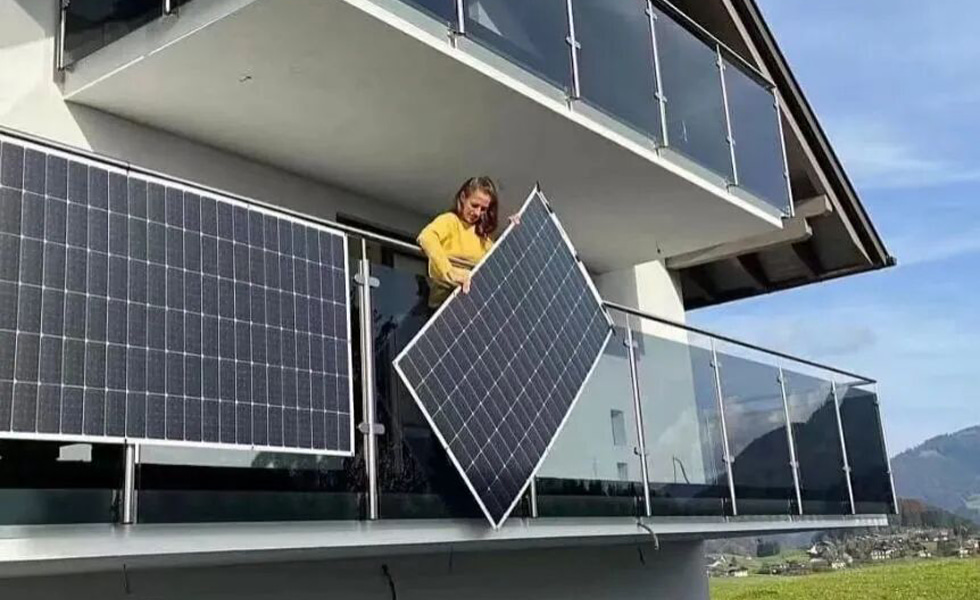
Balcony energy storage has truly taken off.
In just three years, balcony energy storage has evolved from a niche category into a dark horse in the energy market. By 2025, the global market size for balcony PV storage exceeded 13.7 billion RMB, with a compound annual growth rate (CAGR) of over 200% between 2020 and 2025—significantly outperforming the broader residential energy storage market—and this strong growth momentum has continued into 2026.
To understand the source of this growth, one must first identify exactly where the market for balcony energy storage lies.
I. Why Balcony Energy Storage Took Off in Europe First
Currently, the balcony energy storage market is concentrated in Europe, with Germany serving as the pivotal hub. Germany’s early success in this sector was no accident; several key factors drove it.
High electricity prices were the most immediate catalyst. Following regional conflicts in 2022, retail electricity prices in Europe surged; at one point, residential electricity prices in Germany more than tripled compared to 2020 levels. Although prices retreated somewhat by 2025, intraday volatility increased significantly. The market now sees an average intraday price spread of €130 per megawatt-hour (MWh), and the total duration of negative electricity prices has reached approximately 575 hours annually—nearly double the figure from 2020.
For ordinary households, price volatility creates uncertainty regarding electricity costs; consequently, balcony-based solar-plus-storage systems—which allow for self-generation and self-consumption—naturally became a tool to hedge against these fluctuations.
Regulatory easing was the spark that truly ignited the market. In May 2024, Germany passed the "Solar Package" (Photovoltaic Package) legislation, which removed three major barriers in one fell swoop: "plug-and-play" systems under 800W no longer require prior approval and only need a simple online registration after installation; tenants were granted explicit installation rights, with balcony solar systems classified as "privileged equipment"—on par with EV charging stations and accessibility facilities—meaning landlords and homeowners' associations cannot arbitrarily block their installation; and the 19% VAT was waived, with no personal income tax levied on earnings from self-generated electricity. By January 2025, Germany had raised the power output limit to 1,200W and included energy storage modules in subsidized loan programs for residential energy-efficiency upgrades, allowing households to secure up to €1,500 in interest-free loans.
Demand surged quickly following the policy implementation. In 2024, Germany added approximately 435,000 balcony solar units, accounting for 44% of the country's new solar installations that year; by the end of 2025, cumulative registrations surpassed 1.33 million units—a fourfold increase in just two years.
Alongside the rapid expansion of installations, the adoption rate of energy storage paired with balcony solar systems has steadily risen; an increasing number of households are moving beyond standalone solar setups to adopt integrated solar-plus-storage solutions.
Product maturation has made this widespread adoption truly feasible. Traditional residential storage systems rely on a multi-layered chain involving brands, agents, and installers; a complete system costs between €10,000 and €20,000 and requires professional site assessment, installation, and grid commissioning—resulting in a heavy supply chain and high costs.
In contrast, balcony solar-plus-storage systems are sold much like home appliances via B2C direct sales. These standardized, all-in-one kits can be installed by users themselves, eliminating the need for professional installation crews.
Costs have also continued to decline; by the first quarter of 2026, the industry's average cost per watt had dropped to 1.37 RMB/W. Basic kits range from €1,500 to €2,000, with the payback period for some products shortened to just one or two years.
At the same time, barriers to adoption in various living situations have been removed. With over half of Germany's population living in rented accommodation, rooftop solar adoption faced hurdles regarding property rights, making widespread rollout difficult. However, balconies and terraces are areas where tenants have autonomy. Once policies granted tenants the right to install these systems, pent-up demand for household energy solutions was unleashed, driving a massive influx of new users for balcony energy storage.
Germany's demonstration effect quickly triggered a chain reaction across Europe.
In the Netherlands, with the net metering policy set to be fully phased out by 2027, residents began investing in energy storage early to offset potential increases in electricity costs. In the second quarter of 2026 alone, over 37,600 balcony energy storage units were sold—nearly doubling quarter-over-quarter and surging 47-fold year-over-year—with quarterly sales volume exceeding the total accumulated stock of the previous three years. Belgium, Austria, and Switzerland have successively streamlined registration processes for balcony solar-plus-storage systems, while Italy has introduced a 50% personal income tax deduction covering residential PV systems—including storage—thereby boosting household interest in energy storage adoption. Meanwhile, countries in Eastern and Southern Europe are leveraging subsidies from the EU’s €86.7 billion Social Climate Fund to launch their balcony energy storage markets between now and 2026.
II. Reshaping the Landscape: Consumer Electronics Giants Take the Lead
While the sectors for traditional utility-scale and standard residential energy storage have long been dominated by power equipment companies, the emerging balcony energy storage market—characterized by lightweight designs, appliance-like usability, and a consumer-facing (C-end) focus—has attracted a new breed of players with vastly different profiles.
Traditional utility-scale and residential storage markets rely on grid-connection technology, system integration, engineering delivery, and offline sales channels. In contrast, balcony energy storage breaks away from the heavy engineering equipment model; success here hinges on standardized, all-in-one products, direct-to-consumer online sales, user experience, aesthetic design, and cost control.
These are precisely the areas where traditional power equipment manufacturers often lack strength, creating a strategic opening for consumer electronics companies.
Leveraging mature cross-border e-commerce channels, rapid product iteration, and experience with localized overseas operations, Chinese portable power station and consumer electronics companies have quickly established a foothold in the European market, forming the industry's leading tier. Data from Frost & Sullivan indicates that, by revenue, the top three brands in the global balcony solar-plus-storage market in 2025 are all Chinese enterprises.
III. The Next Phase of Balcony Energy Storage: Where Are the Bottlenecks?
The boom in the European market confirms the commercial potential of balcony energy storage; however, significant practical hurdles remain beneath the sector's rapid growth.
In the UK, Amendment SI 2026/848—which took effect on August 27—officially legalized "plug-and-play" balcony solar systems but excluded energy storage components from this authorization. California’s Senate Bill 868 follows a similar pattern, focusing primarily on solar power generation equipment without explicitly mandating or defining the inclusion of energy storage batteries.
It is evident that some countries and regions remain cautious regarding the issue of balcony energy storage. Energy storage batteries are bidirectional—capable of both drawing power from the grid to charge and discharging power back into it—and involve critical considerations regarding thermal management and fire safety. Consequently, their installation and operation are more complex, and they present greater regulatory challenges.
Given that battery malfunctions can lead to thermal runaway and fire safety hazards, the concerns raised by regulators are well-founded.
Another layer of pressure stems from competition within the sector. The supply chain for balcony solar-plus-storage systems has matured significantly, leading to product homogenization. As barriers to entry have lowered, a multitude of small and medium-sized players have flooded the market; most manufacturers focus solely on basic storage functions and price competitiveness, lacking differentiated technological innovation, refined adaptation to specific usage scenarios, and upgrades in intelligent scheduling capabilities.
Overall, the balcony energy storage sector is at a pivotal juncture, characterized by the realization of market dividends and the easing of industry regulations. In the short term, the benefits of the European market will continue to materialize, with more countries likely to follow suit by legalizing balcony solar-plus-storage systems. In the long run, however, competition will move beyond mere pricing; only by proactively establishing strengths in technology, distribution channels, and user engagement can companies secure a firm foothold in the next phase of industry development.