News
  • Nation's Top Photovoltaic Base in Coal Mining Area Built by China Power Construction, Now Operational
    Nation's Top Photovoltaic Base in Coal Mining Area Built by China Power Construction, Now Operational
    March 03, 2026
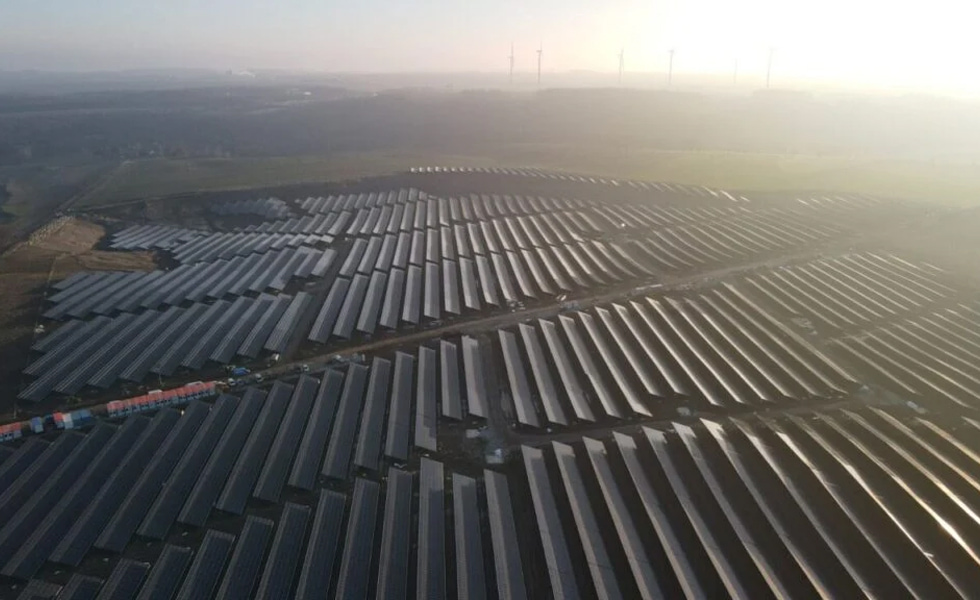
    Recently, the Ningxia Lingwu 4 million kW Coal Mining Subsidence Area New Energy Base, the largest single photovoltaic project in China's coal mining subsidence area, in which China Power Construction Corporation (China Power) participated, was completed and put into operation. This will provide strong impetus for the efficient transformation of resource advantages in Northwest my country's energy base and high-quality economic and social development.   The Ningxia Lingwu 4 million kW Coal Mining Subsidence Area New Energy Base is an important component of my country's second batch of large-scale wind and photovoltaic bases in the "desert and Gobi" areas. It covers approximately 120,000 mu (about 8,667 hectares) and transmits over 7 billion kilowatt-hours of clean energy annually. China Power's subsidiaries, including Shandong Electric Power Construction Corporation III, Hubei Engineering Company, Northwest Institute, Guiyang Institute, Shanghai Electric Power Construction Corporation, Shandong Electric Power Construction Corporation, and Power Construction Nuclear Power Company, participated in its construction.   The completion and operation of the Ningxia Lingwu 4 million kW Coal Mining Subsidence Area New Energy Base marks the full completion of the Ningxia coal mining subsidence area project, which covers an area of ​​180,000 mu (about 12,667 hectares) and has a total installed capacity of 6 million kilowatts. The Ningxia Coal Mining Subsidence Area Project comprises the Ningdong 2 million kW Coal Mining Subsidence Area Composite Photovoltaic Base and the Ningxia Lingwu 4 million kW Coal Mining Subsidence Area Composite Photovoltaic Base, covering a total area equivalent to approximately 16,000 football fields. It includes six 330 kV step-up substations and 200 kilometers of transmission lines.   The project will transmit approximately 10.8 billion kilowatt-hours of clean electricity annually through the Ningxia-Zhejiang ±800 kV Lingshao UHVDC transmission line, contributing to the nation's efforts to optimize energy allocation and build a stable clean energy supply system. Simultaneously, combined with photovoltaic desertification control, it will reduce wind speed and evaporation, thus restoring desertified land.   Upon full completion and operation, the project will meet the annual electricity needs of 7.2 million households, saving approximately 3.24 million tons of standard coal. Its economic, social, energy-saving, and environmental benefits are significant, making a crucial contribution to my country's goal of achieving a low carbon footprint and promoting ecological protection and high-quality development in the Yellow River Basin.
  • 1GWh! Chinese company wins bid for Africa's largest stand-alone energy storage project
    1GWh! Chinese company wins bid for Africa's largest stand-alone energy storage project
    February 26, 2026
    With the arrival of spring, good news travels across the sea.   Recently, China Energy Engineering Corporation International Group, in conjunction with Zhejiang Thermal Power and Southwest Electric Power Design & Research Institute, won the bid for Africa's largest independent energy storage project: the Nefertiti 1000 MWh energy storage project in Benban, Egypt.   The project is located in the Benban Photovoltaic Industrial Park in Aswan, Egypt. The project adopts an EPC (Engineering, Procurement, and Construction) general contracting model, and its construction includes the design, procurement, construction, and commissioning of a 220 kV substation, the energy storage plant, and the upgrading and renovation of the adjacent substation.   Upon completion, the project will provide 1 GWh of power load regulation capacity, effectively enhancing the stability of the Egyptian power grid and helping Egypt achieve its strategic goal of "42% clean energy by 2030," thus transforming it from an "energy-producing country" into a "green energy export center."   According to reports, China Energy Engineering Corporation (CEEC) entered the Egyptian market in 2010. Leveraging its integrated advantages across the entire industry chain, it has undertaken more than 10 key projects in the fields of new energy, power transmission lines, and water utilities, with a cumulative contract value exceeding US$3 billion. These include landmark projects such as the Abydos Phase II 1200 MW photovoltaic-storage project (Africa's largest single photovoltaic-storage project) and the Kamwonbo 500 MW photovoltaic power station (Egypt's largest single photovoltaic project), providing strong green power for the high-quality joint construction of the Belt and Road Initiative between China and Egypt.   Meanwhile, CEEC also announced a successful bid in the domestic energy storage market. On February 24, 2026, CEEC Xinjiang Electric Power Design Institute Co., Ltd. won the EPC general contracting project for the 100 MW/400 MW hybrid independent energy storage power station construction project in Gaochang District, Turpan Zhitai Power Development Co., Ltd.   Located in Turpan City, Xinjiang Uygur Autonomous Region, the project involves the construction of a 100,000 kW/400,000 kWh grid-type energy storage project, along with the construction of a 110kV booster station, a new 110kV overhead transmission line, and the expansion of the opposite bay.
  • Is the EU targeting Chinese inverters?
    Is the EU targeting Chinese inverters?
    February 04, 2026
    Is Europe about to target solar inverters? Recently, inside the European Parliament building, the European Commission was working on revising the Cybersecurity Act. The Vice-President of the European Commission responsible for Technological Sovereignty, Security and Democracy proposed introducing a list of "high-risk equipment manufacturers" to strengthen the EU's cybersecurity resilience and capabilities. Companies included on this list would face restrictions or even exclusion from the EU's critical infrastructure markets.   This draft bill plans to phase out components and equipment from so-called "high-risk suppliers" in 18 key areas, including 5G communications, semiconductors, power systems, autonomous driving, and medical equipment. Although the document does not explicitly name any country or company, its policy direction is clear and it is widely seen as another measure to contain Chinese high-tech companies.   It is worth noting that shortly before this bill was discussed, a Financial Times report sparked concerns in the solar photovoltaic industry about the future of the European market. The article pointed out that the European Commission was studying whether it could gradually restrict the entry of some solar inverters considered high-risk into the European market through a new cybersecurity framework, including products from Chinese manufacturers.   However, this is only the Financial Times' perspective; the European Commission has not yet made a clear decision to ban them. However, this does not preclude the possibility that the European market will not take action against Chinese photovoltaic inverters in the future.   After all, according to publicly available information from the European Commission, the contents of the bill's list are currently unclear, but this trend has already caused some unease among many inverter manufacturers.   Solar inverters face another crackdown! Even before the European security draft bill, the US had already shown hostility towards Chinese solar inverters. On November 14th last year, over 50 Republican members of the House Freedom Caucus jointly wrote to the Department of Commerce, citing "potential national security risks," calling for a ban on solar energy storage inverters from FEOC entering the US market, primarily targeting products manufactured in China. In the letter, the lawmakers expressed concern about the expanding application of Chinese-made solar and energy storage inverters, stating that such equipment could be maliciously used, thereby endangering the security of the US power grid, and specifically cited an unreliable Reuters report. In May 2025, a Reuters report indicated that some Chinese-made inverters might contain undeclared wireless communication modules, raising concerns about potential risks to the power grid. Subsequently, the US Department of Energy (DOE) coordinated with its national laboratories to conduct technical testing on approximately 30 inv...
  • President Launches Kyrgyzstan's Premier Solar Plant
    President Launches Kyrgyzstan's Premier Solar Plant
    December 30, 2025
    On December 24th local time, the 100 MW Chuy Oblast photovoltaic power station, Kyrgyzstan's first large-scale photovoltaic project, in which China Energy Engineering Corporation Xinjiang Institute (CEEC Xinjiang Institute) participated as one of the EPC general contractors, successfully completed grid connection and power generation. Kyrgyz President Sadyr Japarov attended the ceremony and delivered a speech, witnessing this milestone moment.   In his speech, President Sadyr Japarov stated that the project not only introduces advanced new energy construction experience to Kyrgyzstan but also injects new impetus into the country's energy security and sustainable development. He highly praised the project team's professional capabilities and execution efficiency, and affirmed the contributions of Chinese enterprises to Kyrgyzstan's new energy sector.   The 100 MW Chuy Oblast photovoltaic project officially commenced in July 2025. Thanks to the meticulous organization and efficient execution of the project team, the project was completed and connected to the grid in just six months, once again demonstrating the widely acclaimed "China Speed." This is Kyrgyzstan's first large-scale new energy project to be completed and put into operation, and also its first large-scale photovoltaic power station, which is of pioneering significance for promoting the optimization of the country's energy structure and increasing the proportion of clean energy.   As a typical demonstration project of energy cooperation under the "Belt and Road" framework, the successful grid connection of the project marks a new stage in the cooperation between the two sides in the field of green and low-carbon development, and lays a solid foundation for subsequent multi-field energy cooperation.
  • Egypt's 1GW Solar + 600MWh Storage Megaproject Powers Up With New Financing
    Egypt's 1GW Solar + 600MWh Storage Megaproject Powers Up With New Financing
    December 25, 2025
    According to foreign media reports, the International Finance Corporation (IFC) recently partnered with renewable energy developer AMEA Power and Japan's Kyuden International Corporation to jointly construct a large-scale photovoltaic power plant and its supporting battery energy storage system (BESS).   The IFC will lead the provision of $571.8 million in overall debt financing. In addition, the IFC has mobilized several partner institutions to invest in the project company, Abydos For Renewable Energy, for the development, construction, and operation of the "Abydos II" project.   The project is located in Aswan Governorate, southern Egypt, and will consist of a 1,000 MW photovoltaic power plant with an integrated 600 MWh battery energy storage system.   The funding sources are as follows: the IFC will directly provide an $83.5 million senior loan; international institutions such as the Italian Depository & Loan Bank (CDP), the Dutch Development Bank (FMO), the German Investment and Development Corporation (DEG), the British International Investment (BII), and the OPEC International Development Fund will contribute a total of $465.2 million; and the Climate Investment Fund's Clean Technology Fund will provide a $20 million concessional senior loan.   This new investment in the partnership represents another step in Egypt's green energy transition, following the joint development of the dual 500 MW Abydos solar and 500 MW Amunet wind power projects in 2022, and the financing of Egypt's first utility-scale battery storage system earlier this year.   IFC stands for International Finance Corporation, one of the five largest member institutions of the World Bank Group.
  • 1.005GW/3.01GWh! The world's largest energy storage power station goes into operation!
    1.005GW/3.01GWh! The world's largest energy storage power station goes into operation!
    December 16, 2025
    On December 12th, the Inner Mongolia Energy Group's 400MW/1.600MW independent energy storage project in Dengkou County successfully connected to the grid and completed its first batch of energy storage unit charge and discharge cycles. This marks a significant increase in the total capacity of the Inner Mongolia Energy Group's Dengkou energy storage power station to 1.005MW/3.01MW, making it the world's largest operational energy storage power station to date.   The project employs a hybrid technology route combining vanadium redox flow batteries and lithium iron phosphate batteries, offering the dual advantages of long-term energy storage and rapid response. The vanadium redox flow battery energy system, as a key technology demonstration project under the Inner Mongolia Autonomous Region's "open competition for key projects" initiative, aims to achieve a single-cell rated current density of 500mA/cm²@80% and a system energy efficiency exceeding 72%, significantly surpassing relevant industry battery performance standards and providing important guidance for the rational design of flow batteries. Since its commencement, the project completed all main construction and grid connection commissioning in just over two months. From obtaining all necessary permits to grid connection, it took only 139 days, and from the official start of construction to grid connection for charging and discharging, only 80 days. Upon completion, the Dengkou Energy Storage Power Station will have a total capacity of 1,005 MW/3,010 MW, making it the world's largest operational energy storage power station.   Energy storage power stations possess the dual attributes of load and power source. They can both peak shaving and valley filling, supporting the power grid, and promote the consumption of new energy sources and improve the utilization rate of wind and solar power. They are key to achieving integrated development of electricity with energy consumption, industry, and the power grid.   The new energy company has already built photovoltaic projects with an installed capacity of 4.45 million kilowatts in Dengkou County. After the completion and commissioning of the 400,000 kilowatts/1.6 million kilowatt-hour independent energy storage project in Dengkou County, it will significantly improve the region's new energy absorption capacity and power system stability, provide greater development space for sand control and wind power-photovoltaic integrated projects, and provide key support and demonstration model for Inner Mongolia Autonomous Region to build a "new power system integrating source, grid, load and storage".
  • Italy's latest tender: 7.69GW of photovoltaic power, HJT and other modules can enjoy an additional 5% premium.
    Italy's latest tender: 7.69GW of photovoltaic power, HJT and other modules can enjoy an additional 5% premium.
    December 09, 2025
    As part of the first tender for Italy's Fonti di Energia Rinnovabile (FER)X transition program, the Italian government has awarded 7.698 GW of capacity to 474 solar photovoltaic (PV) projects.   Organized by the Italian energy management agency, Gestore dei Servizi Energetici (GSE), the average price of electricity (EPI) for successful solar projects was €56.825/MWh. The highest winning bid was €62.675/MWh, and almost all of the nearly 8 GW of available solar capacity was allocated.   In contrast, only 29 wind power projects, totaling 940 MW, were awarded capacity in the tender, with an average price of €72.851/MWh.   Another difference between solar PV and wind power projects is that one-third of the successful wind power projects were renovation projects—including upgrades and expansions—accounting for more than half of the total 940 MW capacity. Of the approved solar projects, only one was an upgrade or expansion project. According to the FER X tender plan, 473 new projects will commence construction.   Most solar projects also have relatively small installed capacities, with 353 projects having a capacity of 10MW or less, accounting for 74.5% of the approved solar projects. In contrast, the wind power sector is different, with 75.9% of projects having a capacity between 10 and 50MW.   Although the number of solar projects approved in the tender for a capacity exceeding 50MW was the smallest, with only 47 projects approved, these projects account for over 4GW of installed capacity, far exceeding all technology types and project sizes. The largest approved solar project is a 300MW power plant project located in Castel Di Iudica, Catania, Sicily.   The completion of this tender means that most bidding projects have secured capacity allocations; in September, a total of 12 GW of renewable energy capacity (particularly 10 GW of solar photovoltaic capacity) participated in the bidding, aiming to obtain government Contracts for Difference (CfDs).   Filling the “Gap” in Italy’s Energy Structure   “GSE plays a central role in our country’s energy transition,” said GSE President Paolo Arrigoni at an energy event in Italy this week. “It is transforming from a mere incentive manager into a promoter and facilitator of the energy transition.”   However, Arrigoni pointed out that GSE remains committed to bringing more renewable energy capacity into operation in Italy. He mentioned that as of October 2024, Italy will have approximately 80 GW of renewable energy capacity in operation, while the deployment target for 2030 is 131 GW, leaving a “gap” of 51 GW of renewable energy capacity.   This shortfall will be partially filled by the second round of FERX tenders, which aims to award projects using cells, modules, and components not manufactured in China, and covers technologies such as heterojunction (HJT).   In the sec...
  • Another photovoltaic material price increase; European solar energy agency signs new regulatory initiative.
    Another photovoltaic material price increase; European solar energy agency signs new regulatory initiative.
    December 03, 2025
    On November 27, the Solar Regulatory Initiative in Europe (SSI) and Copper Mark signed an agreement aimed at "promoting responsible copper production and sourcing across the entire solar energy supply chain."   SSI, jointly established by the trade body SolarPower Europe and Solar Energy UK, is a self-regulatory organization focusing on the solar photovoltaic supply chain and sustainability. SSI covers over 70% of global solar manufacturing capacity, and its ESG certification system is an industry benchmark. Copper Mark currently certifies 96 copper production sites. This collaboration will create a closed-loop mechanism encompassing "production compliance certification - supply chain traceability - end-application verification."   The organization stated that with the increasing deployment of solar energy and the rising use of copper in the solar sector, "the necessity for cooperation among key stakeholders in the copper supply chain is becoming increasingly apparent."   The two organizations signed a Memorandum of Understanding (MOU) to analyze the supply chain, identify environmental, social, and governance (ESG) risks, and provide solutions to improve the overall performance of the industry. Copper Mark is a supply and compliance assurance framework for the copper, molybdenum, nickel, and zinc supply chains.   Copper has long been a major component of solar power transmission infrastructure and cables, and is increasingly becoming a crucial part of solar photovoltaic cell manufacturing. Standard processes heavily rely on silver as a conductive material in solar cells, but with increasing manufacturing capacity and advancements in cell technology, the cost and scarcity of silver are beginning to pose challenges.   The solar manufacturing industry's share of global silver demand is growing, and silver's scarcity and high cost are forcing technological innovation within the industry. As Wang Yongqian, chief scientist at the Chinese solar manufacturer Aiko Solar, discussed, the industry is accelerating the metallization process of copper-based cells, replacing silver, and copper demand in the solar sector is expected to surge further over the next five years.   According to a recent report, the energy transition, driven by solar manufacturing and grid expansion, is likely to be the main driver of copper demand growth over the next decade. The report's author, Wood Mackenzie, stated that geopolitical pressures as countries seek to reduce their reliance on imports will accelerate copper demand growth in the renewable energy sector.   “This collaboration with Copper Mark is a significant step towards building a truly integrated and responsible production model across the solar energy supply chain,” said Rachel Owens, CEO of SSI.   “By connecting upstream and downstream assurance efforts, we can enhance transparency and accountability from raw materials to finished solar products. Our partners...
1 2 3 13
A total of13pages

Leave A Message

Leave A Message
If you are interested in our products and want to know more details,please leave a message here,we will reply you as soon as we can.

Home

Products

whatsapp