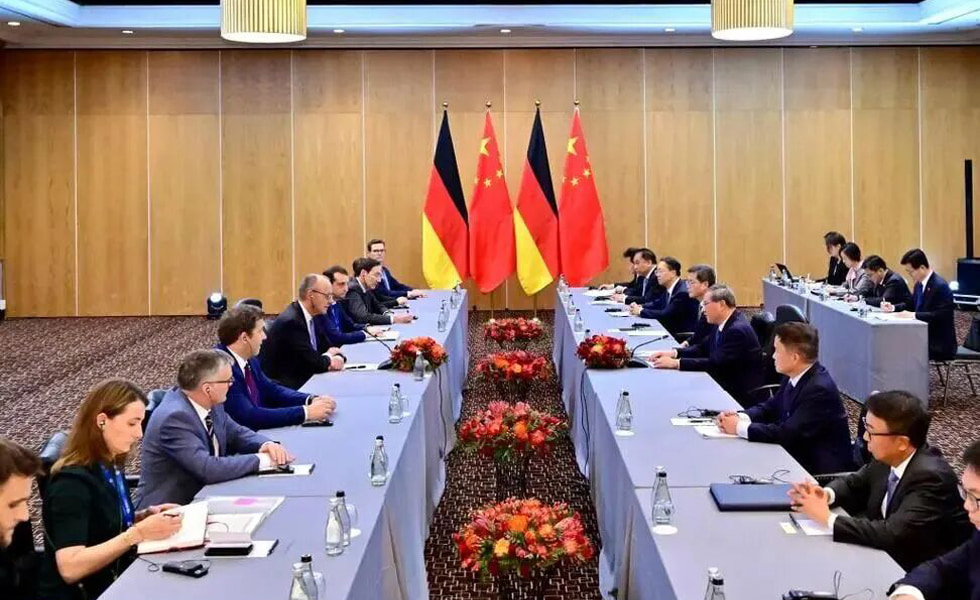
Recently, with the successful conclusion of German Chancellor Merz's official visit to China, cooperation on energy transition and climate change has once again become a top priority in bilateral exchanges and development.
As leading global pioneers in energy transition and key equipment suppliers, China and Germany engaged in in-depth dialogue in the field of new energy. This visit, led by Chancellor Merz, marked his first official visit to China since taking office, with a delegation of over 200 people. This high-profile delegation, comprised of executives from 30 leading companies, included representatives from energy and industrial giants such as Siemens Energy, BMW, and Volkswagen, quickly making energy a focal point of the visit.
For many years, Germany has served as the "engine" of Europe's energy transition, with its photovoltaic market maintaining a robust growth momentum. According to the latest data from the German Federal Network Agency (Bundesnetzagentur), Germany's cumulative installed photovoltaic capacity continues to climb, accelerating towards its 2030 photovoltaic installation target. In this process, Chinese photovoltaic products, leveraging their strong supply chain advantages and technological innovation, have played an indispensable role as "enablers."
Data shows that in 2025, China's photovoltaic (PV) module exports to Germany increased by approximately 18% year-on-year, reaching $2.8 billion, accounting for 7% of China's total PV module exports. In the first quarter of 2026, Germany became China's largest importer of PV modules in Europe, with imports increasing by 32% year-on-year.
Besides traditional solar PV panels, exports of related products such as inverters also remained stable. In 2025, China's inverter exports to Germany reached $4.435 billion, accounting for a significant proportion of China's total inverter exports, making Germany one of the important markets for inverter exports.
However, as the proportion of renewable energy generation in Germany continues to increase, the volatility of the electricity market is also intensifying. The traditional profit model relying solely on grid connection for PV power generation is facing challenges. How to achieve "revenue stacking" through deep integration of "PV + energy storage" has become a core issue for the energy industry in Germany and even the entire European region.