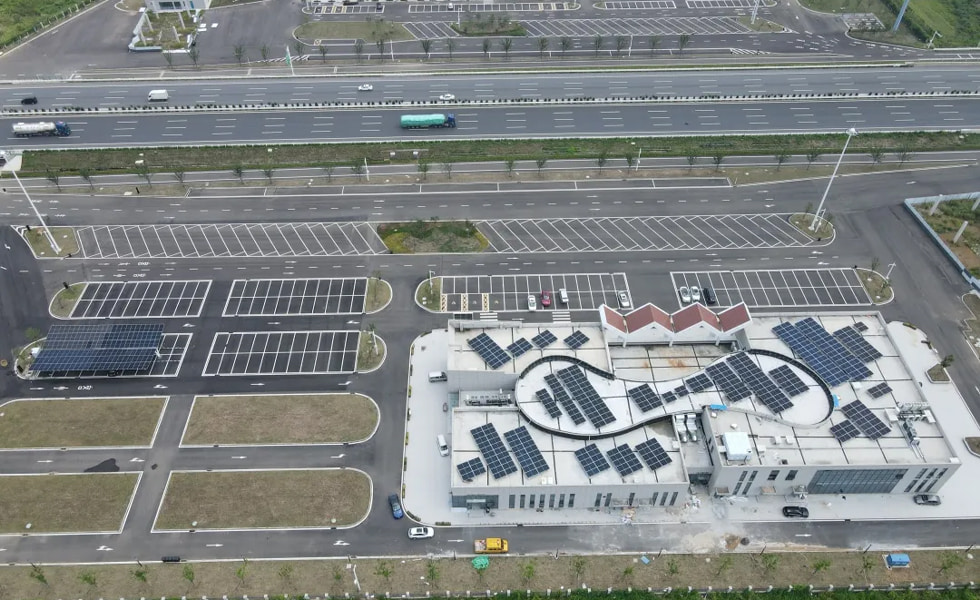
On February 2, 2026, the charging station in the North Zone of the Tonglu Service Area on the Hangzhou-Qiandao Lake Expressway (hereinafter referred to as "the Service Area") officially commenced operation, forming a north-south integrated photovoltaic, energy storage, and charging network with the South Zone. This marks the full completion and operation of the largest highway charging station in China.
This project is a key project deeply involved and collaboratively promoted by the New Energy Investment and Development Group, a subsidiary of the Hangzhou Urban Construction Investment Group. It deploys 216 charging piles in the North and South Zones of the Service Area, covering various charging modes including slow charging, fast charging, and ultra-fast charging. This can meet the charging needs of different vehicle models and in different scenarios, and is expected to meet the charging needs of over 6,000 vehicles per day at its peak. This will effectively solve the charging problem during peak holiday travel periods and alleviate the "range anxiety" of new energy vehicle owners.
The project deeply integrates photovoltaic, energy storage, and charging systems to build a highly efficient and collaborative smart energy microgrid. The service area's total installed photovoltaic capacity in its north and south sections reaches 3096.09 kWp, with the south section having 2705.49 kWp, which was connected to the grid in November 2025, generating an average of approximately 218,600 kWh per month, and equipped with a 200 kW/430 kWh energy storage system. The north section has 390.6 kWp of installed photovoltaic capacity, which will operate in conjunction with the south section after grid connection. Furthermore, the planned 240 kW/440 kWh energy storage system in the north section is expected to begin construction after the Spring Festival in 2026, further improving the efficient energy closed loop of "photovoltaic priority, energy storage regulation, and green electricity charging."
Currently, energy storage technology is rapidly reshaping the energy landscape. In this transformation, the cross-industry integration of "energy storage + highway" is becoming a super lever to unlock a trillion-dollar market. From Tesla's Megapack to CATL's "photovoltaic-storage-charging-inspection" system, from "zero-carbon demonstrations" in Chinese highway service areas to Europe's Supercharger corridors, a disruptive energy revolution has quietly entered the fast lane.
Especially during the Spring Festival, energy storage has become indispensable, with more and more highways seeing its presence on daily commutes.
In the highway sector, the Linyi service area on the Beijing-Shanghai Expressway has built the world's first integrated "photovoltaic + energy storage + charging" demonstration station, with a storage capacity of 5MWh, capable of meeting the charging needs of 1,000 new energy vehicles daily and reducing carbon emissions by over 2,000 tons annually. Companies are also actively entering the energy storage + transportation sector, securing a leading market position. Previously, BYD launched the "Magic Cube Energy Storage System," covering highway service areas; NIO plans to build 3,000 battery swapping stations by 2025, with 90% deployed on highway networks. The State Grid is building a "highway photovoltaic-storage-charging demonstration belt," while PetroChina and Sinopec are accelerating the "integrated storage and charging" transformation of their gas stations. Huawei and CATL have jointly built an "intelligent energy storage cloud platform," achieving a 20% increase in energy storage system efficiency through AI scheduling.
In addition, highway groups across the country have actively responded to the national call and launched a series of innovative initiatives aimed at combining photovoltaic power generation technology with transportation infrastructure to explore various application scenarios.
• Jiangsu Province
As early as 2021, the Jiangsu Provincial Department of Transportation issued a notice on carrying out the construction of green transportation projects in Jiangsu Province. It required the completion of 10 regional green transportation demonstration projects in counties (cities, districts) and 40 thematic green transportation projects by 2025. Furthermore, projects that pass the acceptance inspection by relevant departments and experts will receive appropriate subsidies, with each thematic or regional project receiving a subsidy of no more than 3 million yuan in principle.
Suzhou Transportation Investment Group: In September 2023, the first "photovoltaic-storage-charging integrated" charging station in a highway service area of Jiangsu Province, jointly invested by Suzhou Transportation Investment Group Co., Ltd. and GCL (Group) Holdings Co., Ltd., was put into operation.
The project is located in the Baiyanghu Service Area of the Changtai Expressway, consisting of two stations, east and west, with a total installed capacity of 53kWp for photovoltaic carports, a storage system capacity of 3.72MWh, and a total charging pile power of 1920kW.
Nanjing Transportation Group: In September 2023, the integrated photovoltaic-energy storage-charging station at the Qingxiu Service Area of the Nanjing-Ma'anshan Expressway, a subsidiary of Nanjing Transportation Group, officially commenced operation, becoming the largest integrated photovoltaic-energy storage-charging station in a Jiangsu Province expressway service area.
Phase I of the project completed the construction of 16 new energy charging piles and 32 charging parking spaces, with a total charging power of nearly 1,000 kilowatts and energy storage exceeding 200 kilowatt-hours. It is expected to generate nearly 600,000 kilowatt-hours of electricity annually, saving over 450 tons of carbon emissions.
• Anhui Province
Anhui Expressway Group mentioned in its 2022 Environmental, Social and Governance Report that it reduced greenhouse gas emissions by increasing the use of clean energy, promoting the construction of new energy projects such as photovoltaics, and advancing the "gas-to-electricity" conversion of commonly used equipment. In 2022, the company's carbon dioxide emissions from direct energy consumption decreased by 398.91 tons year-on-year. Case Study: Hefei Ring Expressway South Section Photovoltaic Project – Building a “Zero-Carbon” Park to Help Achieve Carbon Neutrality. Taking the renovation and upgrading of the Hefei Management Office as an opportunity, the company innovatively created the Jinzhai Road toll station and the Hefei Management Office’s “zero-carbon” toll management park. The project adopts a photovoltaic + charging pile system and is equipped with a 500 kW/1000 kWh energy storage system, enabling 100% green electricity supply to the toll station management park. After completion, the project can use a smart energy management platform to monitor, analyze, and intelligently manage carbon emission data from photovoltaics, energy storage, lighting, and overall energy flow within the park in real time, effectively reducing carbon emissions and contributing to the achievement of carbon neutrality goals.
• Shandong Province
On August 4, 2023, CCTV broadcast live from the Zaohe Expressway Zero-Carbon Service Area, revealing my country’s first “transportation and energy integration” expressway built by China Energy Engineering Corporation. This project, based on the Zaohe Expressway in Shandong Province, utilizes available land such as service areas, slopes, toll stations, and interchange ramps to install distributed photovoltaic, wind power, and energy storage systems. It aims to develop new energy resources along the route, including wind and solar power, and construct an intelligent microgrid system to provide green and clean energy for transportation vehicles.
On February 4th of this year, Shandong Expressway Group issued a direct procurement announcement for the Zaozhuang photovoltaic project's energy storage system EPC general contracting unit. The total energy storage capacity is approximately 2.6MWh, with a budget of 3.9 million yuan, equivalent to a unit price of 1.5 yuan/Wh. In the Linyi photovoltaic project's energy storage EPC procurement, the project budget is 2.8 million yuan, with a total energy storage capacity of 1.9MWh, equivalent to a unit price of 1.474 yuan/Wh. On March 13th, Shandong Expressway Energy Development Co., Ltd. issued a tender announcement for the energy storage system framework agreement procurement project. The announcement shows that this procurement includes two types of energy storage systems: centralized and distributed, with a total procurement volume of 600MWh. The estimated procurement capacity for centralized and distributed systems is 400MWh and 200MWh, respectively.
• Fujian Province
On the morning of December 1, 2021, Fujian Expressway Energy Development Co., Ltd. held its unveiling ceremony in Fuzhou. In August 2023, Fujian Expressway's first integrated photovoltaic and energy storage power station was put into operation at the Nanyang Service Area.
It is reported that the Nanyang Service Area photovoltaic power station has a containerized integrated energy storage system with a storage capacity of 100kW/200kWh, a distributed photovoltaic installed capacity of 342.36kWp, and an average annual on-grid electricity generation of 315,100kWh. Based on an average coal consumption of 304.9g standard coal/kWh, this can save 105 tons of standard coal annually and reduce greenhouse gas emissions by approximately 359 tons. Similar to the operation model of the photovoltaic power station at the Xiamen Longjue East Service Area, the photovoltaic power station follows the principle of self-consumption and surplus power fed into the grid, which can reduce the grid load on the service area during peak hours and ensure the power supply for production and daily life in the service area.
• Guangdong Province
Two super-fast charging stations were built in the Yuanshan Service Area of the Huida Expressway, each equipped with two 480kW supercharger stacks, 12 fast and supercharger charging bays, an 800KVA prefabricated substation, and two energy storage cabinets. This integrated photovoltaic-storage-charging power station (grid) not only reduces energy consumption but also provides green and clean energy to the service area, offering significant environmental, social, and economic benefits.
• Heilongjiang Province
In July 2023, the first photovoltaic-storage-charging-cooling supercharging station in Northeast China, invested and constructed by Heilongjiang Provincial Transportation Investment Group, was completed and put into operation. Located in the Yinshan Service Area of the Harbin-Zhaozhou Expressway, the project has an installed photovoltaic capacity of 883.14kW, four 100kW/200kWh independent energy storage systems, a total energy storage capacity of 800kWh, and a charging/discharging load capacity of 400kW. This is also Heilongjiang Province's first service area energy storage application pilot demonstration project.
• Guangxi
On September 15, 2023, the "photovoltaic-storage-charging" integrated energy project at the Laibin Service Area, invested and constructed by Guangxi Group Transportation Industry Co., Ltd., a subsidiary of Guangxi Transportation Investment Group Co., Ltd., officially commenced operation. The project has an installed capacity of 1.296MW, with photovoltaic components accounting for 69.32%, charging piles for 3.62%, and energy storage for 21.04%, achieving a three-in-one function of "photovoltaics + charging piles + energy storage."
• Henan
Henan Transportation Investment Group has stated that it will leverage the advantages of its expressway network resources to construct photovoltaic power generation, grid, load, storage, and charging infrastructure, focusing on implementing the "100-10000-10000" project: striving to build and put into operation more than 100 pairs of green and low-carbon service areas, add more than 1000 MW of photovoltaic installed capacity, and more than 10,000 charging spaces within 5 years. This year, the focus will be on key road networks such as the Lianyungang-Huoerguosi Expressway, the Beijing-Hong Kong-Macau Expressway, the Zhengzhou Ring Expressway, and the Daqing-Guangzhou Expressway, constructing photovoltaic, energy storage, and charging/swapping projects. The planned investment exceeds 1 billion yuan, adding over 200 MW of photovoltaic capacity, over 30 MW of energy storage, and over 3,000 charging spaces.
• Hubei Province
In May 2024, Hubei Province's first integrated photovoltaic-energy storage-charging service area was completed in the Xiaogan West Service Area. This project fully utilizes the existing rooftop and roadside space of the service area, constructing a 600kW photovoltaic system, a 400kWh energy storage system, and a 1600kW charging pile system, simultaneously meeting the green charging needs of 25 parking spaces, promoting the "on-demand generation, on-use, and on-storage" of green energy. In March 2024, the first integrated photovoltaic-energy storage-charging-discharge (PV-ESD) battery swapping station on a highway, jointly built by Hubei Transportation Investment Group subsidiary Chutian Company and NIO, officially began operation in the Zhijiang West Service Area of the G50 Shanghai-Chongqing Expressway.