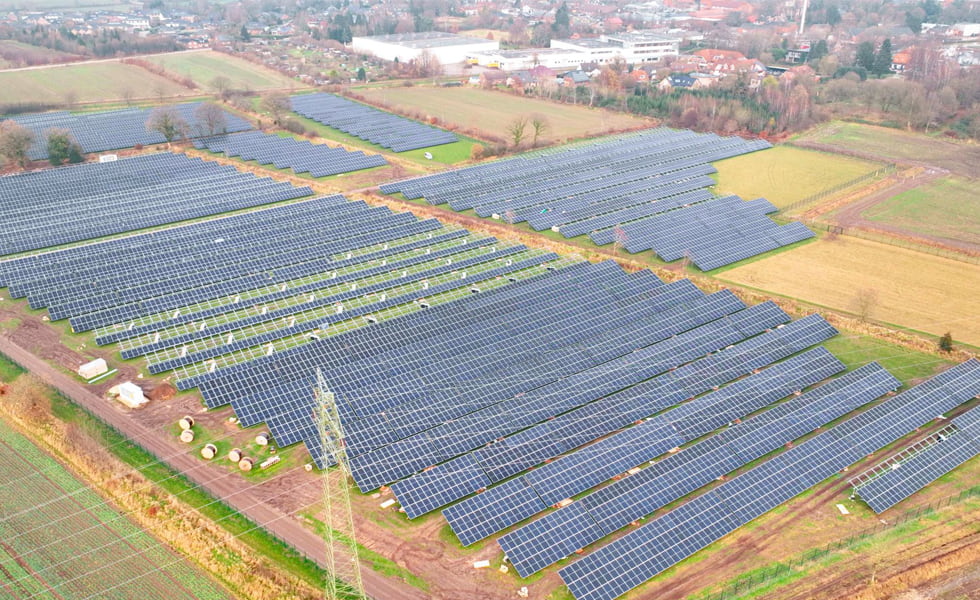
In the three months ending November 2025, US photovoltaic module prices remained stable at slightly above $0.28/watt, but this situation may be fragile due to the upcoming decision by the US solar industry regarding Section 232 compliance.
These are the key findings of Anza's latest report on the US solar and battery energy storage (BESS) sector, released this week. The report notes that although US module prices rose to $0.28/watt (equivalent to RMB 1.97/watt, compared to approximately $0.25/watt in January) since the beginning of the year, they have remained stable since September.
Anza's September report mentioned a price jump as developers sought to start projects operational before September 2nd to receive Investment Tax Credit (ITC) support.
This price stability is reflected across various technologies, with solar panels prices across different technologies showing similar trends throughout the year. As shown in the chart below, prices for monocrystalline passivated emitter-back contact (Mono PERC), TOPCon solar panels, and heterojunction (HJT) modules have all increased since the beginning of the year, but have remained largely stable since April.
The most significant changes occurred in the PERC and TOPCon sectors, where the rankings of the second and third most expensive technology types swapped in September, October, and November.
In September, Anza noted that the September deadline for the Investment Tax Credit (ITC) created a "pull-for-time" effect, compressing projects that should have been undertaken in the second half of the year into a single quarter. Anza anticipates this fragile situation will persist into the new year until the U.S. government issues final guidance on Section 232. Section 232 concerns imports of polysilicon and its derivatives into the United States; given the U.S. solar industry's reliance on such imports, this ruling will have a significant impact on the industry.
According to data from Market Research, Chinese manufacturers continue to dominate global upstream solar manufacturing, with global cell production projected to reach 817.4 GW this year. Ranked by production volume, the top 13 manufacturers are all Chinese companies. The top six manufacturers—Tongwei, LONGi, Trina Solar, Jinko Solar, and JA Solar—account for more than half of the total production, reaching 451.6 GW this year.
US-made solar cells are in a similarly vulnerable position, with prices remaining stable at around $0.45/watt since September. Meanwhile, imported modules are priced much lower, at around $0.26/watt, but have also remained stable.
The biggest change in manufacturing prices comes from imported solar cells assembled in the US, with prices rising from less than $0.35/watt in September to over $0.35/watt in November. From August to November, prices increased by 5.9%, indicating that US module manufacturers are adding a markup to their products, which are typically assembled in the US from imported solar cells.
This reflects the current state of the US solar manufacturing industry, where domestic module assembly capacity far exceeds domestic solar cell manufacturing capacity. Market Research predicts that the US will produce 61.5 GW of modules this year, while cell production will only reach 11.8 GW.
However, Anza anticipates continued investment in cell and module manufacturing capacity in the coming months, with the number of US-based module suppliers expected to increase from 9 in the second half of 2025 to 13 in the first half of 2028. During the same period, the number of US-based cell suppliers is expected to increase from 8 to 11.
Declining energy storage prices could lead to US achieving domestic manufacturing capacity.
Meanwhile, in the Battery Energy Storage System (BESS) sector, prices for various technologies declined last quarter. For a 10 MW, 4-hour system, capital expenditure for AC-side integrated products (AC Wrap) fell from a peak of $236/kWh in May to $212/kWh, a 6.8% decrease since August.
While the price decline for self-integrated cells of the same size was smaller, only 2.6% between August and November, prices still fell to $173/kWh by the end of November.
Large-scale ground-mounted battery energy storage systems (BESS) are showing the same overall trend. For 200 MW, 4-hour projects, Anza reports that capital expenditure for AC-side integrated projects (AC Wrap) reached $194/kWh in November, while capital expenditure for self-integrated products fell to $158/kWh. Compared to May, prices for these two product types decreased by 10.6% and 6.8%, respectively; May was the month with the highest prices this year for the four product types analyzed by Anza.
Looking ahead, Anza expects the US to achieve more domestic manufacturing capacity, predicting that by the first half of 2027, there will be 13 suppliers of battery energy storage system (BESS) cells, modules, and containers in operation in the US. In the second half of this year, however, there are only 3 cell suppliers, 5 module suppliers, and 7 container suppliers in the US.